
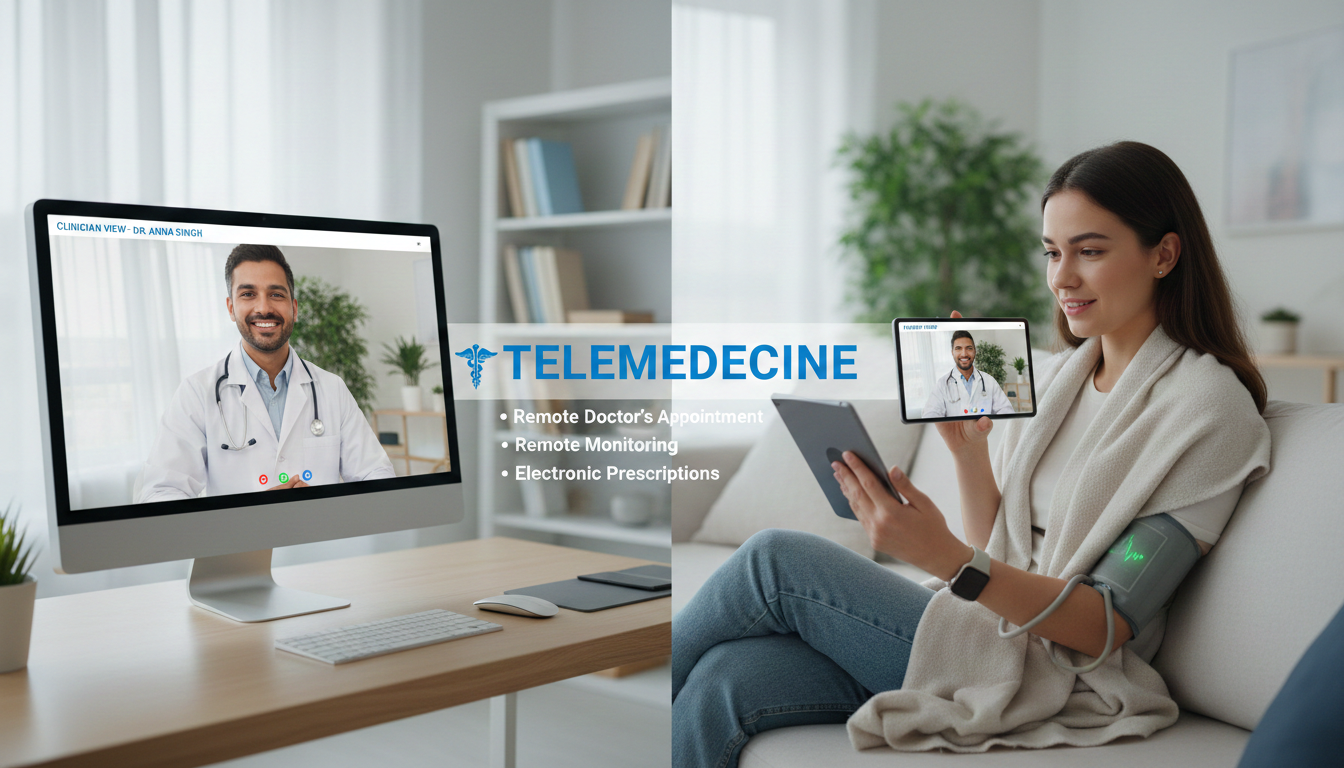
| Telehealth and telemedicine — the terms are used interchangeably every day, yet they mean very different things. For healthcare providers, administrators, and patients choosing a digital care model, understanding the distinction is not just academic. It shapes how you deliver care, how you bill, how you comply with regulations, and how your patients experience your practice. |
Defining the Terms: What Do They Actually Mean?
The confusion between telehealth and telemedicine is understandable both involve delivering healthcare services using technology, and they share significant overlap in tools, platforms, and regulatory frameworks. But the distinction is meaningful, and getting it wrong can lead to billing errors, compliance gaps, and misaligned patient expectations.
What Is Telemedicine?
Telemedicine refers specifically to the remote delivery of clinical medical services by licensed physicians and other medical practitioners. It is the digital equivalent of an in-office medical visit focused narrowly on diagnosis, treatment, and prescription. When a patient video-calls a doctor to discuss symptoms, receive a diagnosis, or get a prescription refilled, that is telemedicine.
Telemedicine is governed primarily by state medical licensing boards, the Drug Enforcement Administration (DEA) for controlled substance prescribing, and CMS reimbursement rules under Medicare and Medicaid. It is a subset of the broader telehealth ecosystem one specifically concerned with clinical encounters between patients and licensed medical providers.
What Is Telehealth?
Telehealth is a broader umbrella term that encompasses all uses of technology to support and deliver healthcare-related services — clinical and non-clinical alike. This includes telemedicine, but also extends to remote patient monitoring, patient education platforms, provider training, administrative services, and mobile health applications.
Think of it this way: all telemedicine is telehealth, but not all telehealth is telemedicine. A nurse practitioner conducting a remote follow-up visit is practicing telemedicine. A hospital system using a patient portal to deliver post-discharge education is using telehealth. A wearable device transmitting continuous blood glucose data to a care team dashboard is telehealth. The ecosystem is vast.
| Quick Rule: If it involves a licensed physician making a clinical diagnosis or writing a prescription remotely, it is telemedicine. If it involves any health-related service delivered through technology — clinical or not — it is telehealth. |
Telehealth vs Telemedicine: Complete Feature Comparison
| Feature / Dimension | Telehealth | Telemedicine |
| Definition | Broad use of technology for all health-related services | Remote clinical services delivered by licensed physicians |
| Scope | Clinical + non-clinical (education, admin, monitoring) | Primarily clinical diagnosis and treatment |
| Who Provides It | Physicians, nurses, therapists, health educators, admins | Licensed physicians and medical practitioners |
| Service Types | Video visits, remote monitoring, patient portals, mHealth apps | Video consultations, phone visits, store-and-forward imaging |
| Technology Used | Apps, wearables, EHR portals, video platforms, AI tools | Video conferencing, secure messaging, diagnostic tools |
| Regulation Body | State health boards + CMS + HIPAA + FTC (for apps) | State medical boards + CMS + DEA (for prescribing) |
| Insurance Coverage | Varies widely by payer and service type | Broadly covered by Medicare, Medicaid, and private insurers |
| Best For | Chronic disease management, population health, patient engagement | Acute care, diagnosis, prescription, specialist referrals |
| Examples | Remote patient monitoring, mental health apps, care coordination | Virtual urgent care, teledermatology, telepsychiatry visits |
| Data Handling | HIPAA applies; broader data ecosystem (wearables, apps) | HIPAA strictly applies to all clinical communications |
Read More :- 11 Interesting Jobs for Nurse Practitioners
Key Differences That Matter for Healthcare Providers
1. Scope of Practice
Telemedicine is bound by the clinical scope of the providing practitioner physicians, nurse practitioners, physician assistants, and other licensed clinicians who are authorized to diagnose and treat. Telehealth encompasses a far wider range of providers: registered nurses, health coaches, therapists, dietitians, pharmacists, and even automated AI-driven health tools.
For a healthcare facility evaluating which model to adopt, this distinction shapes staffing decisions, credentialing requirements, and the types of services you can legally offer to patients under each framework.
2. Reimbursement and Billing
Telemedicine has well-established reimbursement pathways. Medicare, Medicaid, and most private payers have specific CPT codes for synchronous telehealth visits conducted by licensed physicians. The rules around originating site, audio-only visits, and interstate prescribing continue to evolve, but the billing infrastructure is mature.
Broader telehealth services — remote patient monitoring, asynchronous messaging, digital therapeutics — have more variable reimbursement. Coverage depends heavily on the payer, the state, and the specific service. Providers expanding into non-clinical telehealth services must research payer policies carefully before assuming reimbursement.
3. Regulatory Complexity
Telemedicine triggers medical licensing requirements in every state where the patient is located at the time of the visit. Providers must hold an active, unrestricted license in the patient’s state — or operate under an interstate compact such as the Interstate Medical Licensure Compact (IMLC) or the APRN Compact for nurse practitioners.
Telehealth services that do not involve clinical diagnosis — patient education, care coordination, wellness coaching — generally face lighter regulatory requirements, though HIPAA still applies to any service involving PHI, and FTC regulations govern mobile health apps making health claims.
4. Technology Requirements
Telemedicine requires synchronous, real-time video or audio connection between patient and provider in most payer-covered scenarios. The platform must be HIPAA-compliant, with a signed Business Associate Agreement (BAA), encrypted transmission, and documented audit controls.
Telehealth encompasses asynchronous services as well — store-and-forward technology used in teledermatology and teleradiology, remote monitoring dashboards, secure messaging portals, and patient-facing health applications. The technology stack is broader, and so are the compliance considerations.
Which Is Better for Your Healthcare Organization?
There is no universal answer — the right choice depends entirely on your organization’s goals, patient population, and operational capacity. Here is a practical framework for deciding:
Choose Telemedicine If You Need To:
- Provide real-time clinical diagnosis and treatment remotely
- Offer prescription services to established or new patients
- Replace or supplement in-person physician visits for acute or chronic conditions
- Bill commercial insurers, Medicare, or Medicaid for clinical services
- Operate a virtual urgent care, specialty clinic, or primary care practice
Choose Broader Telehealth If You Need To:
- Monitor patients with chronic conditions continuously between visits
- Deliver patient education, discharge planning, or wellness programming remotely
- Coordinate care across multiple providers using shared digital tools
- Support provider training, clinical supervision, or administrative workflows
- Engage patients through mobile health apps or wearable device integrations
In practice, most mature healthcare organizations do not choose one over the other — they build an integrated digital health strategy that uses telemedicine for clinical encounters and broader telehealth tools for everything surrounding those encounters. The combination creates a seamless patient experience and maximizes both clinical outcomes and operational efficiency.
The Future: Convergence, Not Competition
The debate between telehealth and telemedicine is gradually becoming less relevant as the two continue to converge. Integrated platforms now deliver real-time video visits alongside remote patient monitoring, asynchronous messaging, AI-assisted triage, and EHR-embedded care coordination tools — all under one digital roof.
CMS has permanently expanded telemedicine coverage for several service categories post-pandemic, and state telehealth parity laws continue to extend insurance coverage for an expanding range of virtual services. The regulatory environment is maturing in ways that reward providers who build comprehensive, compliant digital health infrastructure — not those who rely on a single tool or channel.
For healthcare providers, the most important takeaway is this: the question is not which is better, but how to use each appropriately. Telemedicine handles the clinical core. Telehealth handles the surrounding ecosystem of support, engagement, and monitoring. Together, they enable a model of care that is more accessible, more efficient, and more patient-centered than traditional in-person care alone can achieve.
Organizations that invest in understanding the distinction — and build operational strategies that honor it — will be best positioned to deliver high-quality, compliant, reimbursable digital healthcare in the years ahead.
Frequently Asked Questions
Q. Is telemedicine and telehealth the same thing?
No — though the terms are frequently used interchangeably, they are not the same. Telemedicine refers specifically to the remote delivery of clinical services by licensed physicians and medical providers, such as diagnosis, treatment, and prescribing. Telehealth is a broader umbrella term that includes telemedicine plus all other health-related technology services: remote monitoring, patient education, care coordination, mHealth apps, and administrative tools.
Q. Which is covered by insurance — telehealth or telemedicine?
Telemedicine — specifically synchronous clinical visits conducted by licensed physicians — has the most established reimbursement pathways under Medicare, Medicaid, and most commercial insurers. Broader telehealth services such as remote patient monitoring and asynchronous messaging are increasingly covered, but reimbursement varies significantly by payer and state. Always verify specific CPT codes and payer policies before billing for any digital health service.
Q. Do I need a separate license to practice telemedicine across state lines?
Yes. In the United States, a physician must hold an active, unrestricted medical license in the state where the patient is physically located at the time of the visit. Multi-state practice is made more accessible through the Interstate Medical Licensure Compact (IMLC) for physicians and the APRN Compact for nurse practitioners, which streamline the licensure process across member states.
Q. What technology is needed to offer telemedicine services?
At minimum, you need a HIPAA-compliant video platform with a signed Business Associate Agreement (BAA), a stable internet connection, and a device with a camera and microphone. For a full telemedicine practice, you will also need EHR integration for documentation, a secure patient messaging system, an e-prescribing tool, and billing software configured for telehealth CPT codes.
Q. Can nurse practitioners and physician assistants practice telemedicine?
Yes, in states that grant them the appropriate scope of practice authority. Nurse practitioners can practice telemedicine independently in full practice authority (FPA) states, while reduced and restricted practice states require physician collaboration or supervision agreements. Physician assistants practice under physician oversight in most states. The rules vary significantly by state and are subject to ongoing legislative change.
Q. What is the biggest risk for healthcare providers using telehealth platforms?
The most significant risks are HIPAA non-compliance, unlicensed interstate practice, and inadequate reimbursement documentation. Providers must use platforms with signed BAAs and end-to-end encryption, verify that they hold the appropriate license in every state where patients are located, and document virtual encounters with the same rigor as in-person visits to support insurance billing and defend against audits.
Read More :- Telemedicine Software Development: key features, integrations & services