
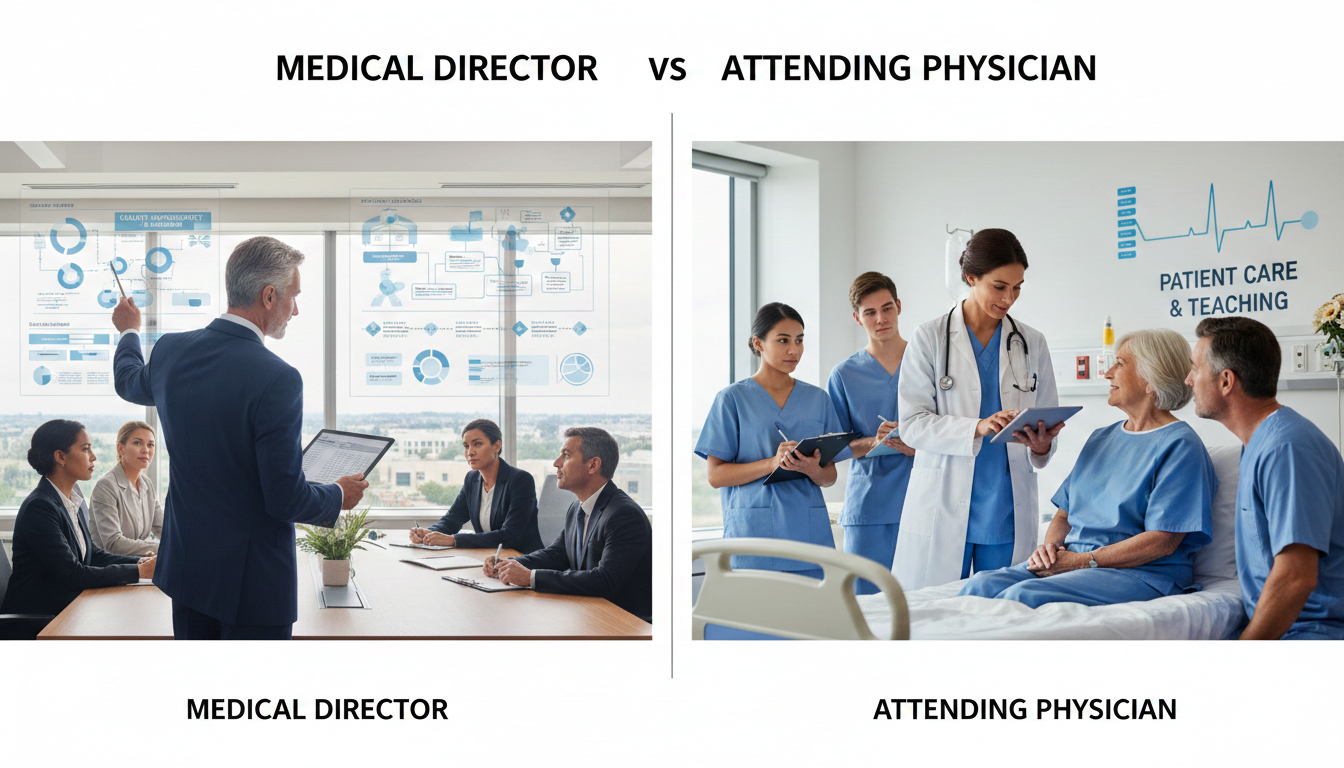
Two physicians walk into a clinic. One reviews protocols, signs standing orders, and answers to the state medical board. The other sees patients, writes prescriptions, and manages individual care plans. Both are doctors. Both are essential. But they are doing entirely different jobs — and confusing the two is one of the most common and costly mistakes clinic owners and telehealth operators make.
The difference between a medical director and an attending physician is not just a matter of title. It is a matter of legal responsibility, scope of authority, and what your clinic is actually required to have in place under state law. Getting this wrong creates compliance gaps that only become visible during an audit, an adverse event, or a medical board investigation — by which point the damage is already done.
This article breaks down exactly how these two roles differ, where they overlap, and which one your clinic, telehealth platform, or wellness organization needs — or whether the answer is both.
Table of Contents
What an attending physician does
An attending physician is a licensed MD or DO who is directly responsible for the diagnosis, treatment, and ongoing care of individual patients. In clinical settings, the attending physician is the final authority on a patient’s care — the person who reviews test results, writes orders, makes treatment decisions, and is legally accountable for the clinical outcomes of the patients under their care.
The attending physician role is reactive and patient-specific. Their work responds to the medical needs that arise encounter by encounter, patient by patient. In a hospital or teaching setting, attending physicians also supervise residents and fellows — but even that supervisory role is anchored in direct patient care, not organizational policy.
Core attending physician responsibilities typically include:
- Conducting patient evaluations, examinations, and follow-up visits
- Diagnosing conditions and establishing treatment plans
- Writing and managing prescriptions and medication orders
- Interpreting lab results, imaging, and diagnostic data
- Coordinating care with nurses, specialists, and other clinical staff
- Documenting patient care to maintain continuity and legal compliance
- Communicating directly with patients and families about care decisions
In telehealth and wellness settings, an attending physician may conduct virtual patient evaluations, oversee prescribing for specific treatments, or provide clinical consultations on individual cases. Their responsibility begins and ends with the patients they personally see and treat.
What a medical director does
A medical director is a licensed physician who holds organizational-level clinical authority over a healthcare facility, clinic, or telehealth operation. Rather than seeing individual patients, the medical director sets the clinical framework within which all patient care is delivered — and is legally accountable for the safety and compliance of that framework.
The medical director role is proactive and system-wide. Where an attending physician responds to what is happening with a patient right now, a medical director is responsible for ensuring that the entire system of care — protocols, staff qualifications, documentation practices, regulatory compliance — is sound before any patient encounter takes place.
Core medical director responsibilities include:
- Drafting and maintaining clinical protocols and standing orders for all services offered
- Supervising and credentialing NPs, PAs, RNs, and other licensed clinical staff
- Conducting regular chart audits to ensure documentation quality and protocol adherence
- Ensuring the organization complies with state medical board regulations, HIPAA, and scope-of-practice laws
- Establishing prescribing standards and medication management policies
- Representing the clinical operation to regulators and being accountable to the state medical board for compliance
- Responding to adverse events, quality concerns, and compliance investigations
In telehealth and multi-state wellness operations, the medical director also navigates the regulatory complexity of operating across multiple state jurisdictions — ensuring that provider licensing, corporate structure, and clinical practices meet the requirements of every state where patients are located.
Side-by-side comparison
| Dimension | Attending Physician | Medical Director |
|---|---|---|
| Primary focus | Individual patient care | Organizational clinical oversight |
| Nature of role | Reactive — responds to patient needs | Proactive — prevents systemic failures |
| Legal accountability | Outcomes for their own patients | All clinical operations of the organization |
| Who they supervise | Residents and fellows (teaching settings) | All NPs, PAs, and clinical staff org-wide |
| Protocol authority | Follows existing protocols for patient care | Creates and approves all clinical protocols |
| Regulatory role | Maintains own licensure and documentation | Accountable to medical board for org compliance |
| Required for | Direct patient care services | Clinics employing NPs, PAs, or RNs |
| On-site required? | Usually yes (or virtual for telehealth) | Not in most states — remote oversight permitted |
The most common mistake clinic owners make
The single most frequent compliance error seen in telehealth companies and wellness clinics is this: assuming that having an attending physician on staff satisfies the medical director requirement.
It does not. An attending physician who sees patients at your clinic fulfills a clinical care role — not an organizational oversight role. Unless that physician has also signed a medical director agreement explicitly defining their oversight responsibilities, they carry zero legal accountability for your clinic’s protocols, your NP staff’s scope of practice, your documentation standards, or your standing orders.
The inverse error also occurs — organizations hiring a medical director but expecting them to also handle patient care loads that require a dedicated attending physician. A medical director’s time is properly spent on protocols, audits, compliance, and staff oversight. Loading them with a direct patient panel compromises both functions.
The cleanest solution for most growing telehealth organizations is a clear, contractual separation: a medical director who owns organizational compliance, and a staffed provider network of attending NPs, PAs, and physicians who handle direct patient encounters.
Not sure which physician role your clinic needs?
LocumTele helps telehealth companies and wellness clinics structure compliant physician oversight — from medical director agreements to full provider staffing across all 51 states. Schedule a free consultation with our team.
Schedule a Free Consultation →Which role does your clinic actually need?
The answer depends on your business model — but for most telehealth and wellness organizations, the answer is that you need both, structured differently.
You need a medical director if:
- Your clinic employs or contracts nurse practitioners, physician assistants, or registered nurses
- Your business offers IV therapy, GLP-1 programs, HRT/TRT, aesthetic procedures, or any clinical service requiring standing orders
- You operate a telehealth platform where NPs or PAs conduct patient evaluations and prescribing
- Your state requires a medical director as a condition of your facility license or business registration
- You operate in multiple states and need physician-level compliance oversight across jurisdictions
You need attending physicians (or NPs/PAs with appropriate supervision) if:
- Your clinic provides direct patient care — evaluations, diagnoses, prescriptions, treatment delivery
- Your service volume requires providers actively seeing patients and managing their care
- You operate a telehealth platform where patients need real-time clinical consultations
The practical structure for a compliant telehealth or wellness organization looks like this: one medical director who owns the clinical governance layer — protocols, compliance, staff oversight, regulatory accountability — and a separate team of clinical providers who deliver direct patient care within the framework the medical director has established.
LocumTele provides both sides of this structure. Our medical director oversight service assigns an engaged, qualified physician to your compliance infrastructure, while our provider staffing network gives you access to licensed MDs, NPs, and PAs for direct patient care — across all 51 U.S. jurisdictions.
Related reading from LocumTele
- What Does a Telehealth Medical Director Actually Do? — complete role guide
- Medical Director Oversight — LocumTele’s physician oversight service
- Provider Staffing & Networks — licensed MDs, NPs, and PAs across all 51 states
- Compliant PC Infrastructure — 51-state professional corporation structure
- Medical Staffing in the USA and Puerto Rico — nationwide coverage guide
Frequently asked questions
Can an attending physician also serve as medical director?
Yes — but only if the arrangement is explicitly contracted, and only if the physician has enough available time to genuinely fulfill both sets of responsibilities. A physician carrying a full patient panel rarely has the bandwidth to also conduct regular chart audits, maintain protocols across all service lines, and manage ongoing regulatory compliance. In practice, combining both roles works best in smaller, single-location clinics with limited service scope.
Is a medical director legally required even if our attending physician is on-site?
In most states, yes. The medical director role is a distinct legal requirement — separate from having licensed physicians delivering patient care. If your clinic employs NPs or PAs, uses standing orders, or is registered as a healthcare facility, state law typically requires a designated medical director with specific oversight responsibilities. An attending physician fulfills the patient care requirement; a medical director fulfills the organizational compliance requirement. They are not interchangeable.
Does a medical director need to see patients at my clinic?
No. A medical director’s core function is organizational oversight — protocols, compliance, staff supervision, chart reviews, and regulatory accountability. They do not need to maintain a patient panel at your clinic. In telehealth and multi-state wellness operations, medical directors typically work remotely, providing oversight through documented chart reviews, virtual check-ins with clinical staff, and regular protocol updates.
What happens if our medical director leaves and we only have attending physicians?
The clinic operates without a required compliance officer until a replacement is in place. This creates immediate legal exposure — your NPs and PAs may technically be practicing without authorized oversight, your standing orders become legally unenforceable, and any adverse event during this period carries significantly elevated liability. Transition planning for medical director succession is a critical operational safeguard.
How does LocumTele structure medical director and attending physician coverage?
LocumTele provides both functions as distinct, clearly structured services. Our medical director oversight service assigns an engaged physician to your compliance infrastructure — covering protocol development, chart reviews, provider supervision, and regulatory accountability. Our provider staffing network supplies licensed MDs, NPs, and PAs for direct patient care across all 51 states. The two services work together to give your organization both layers of physician coverage it legally requires.
Get both roles covered — compliantly, across all 51 states
LocumTele provides medical director oversight and provider staffing for telehealth companies and wellness clinics nationwide. Whether you need organizational compliance coverage, direct care providers, or both — we build the physician infrastructure your clinic requires.
Get a Free Consultation →