
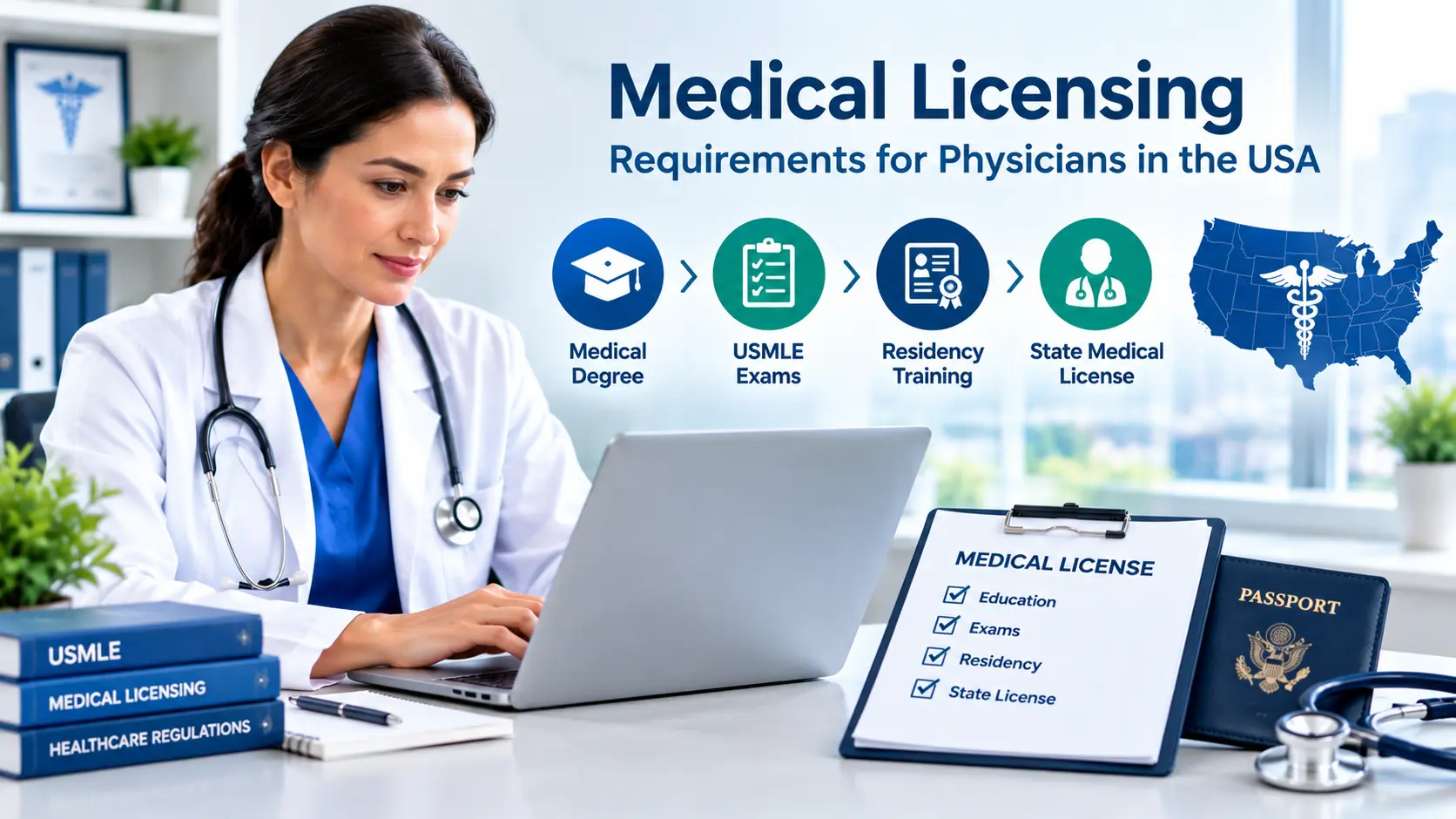
Medical licensing in the United States is one of the most consequential credentialing processes a physician undertakes and one of the most frequently misunderstood in its complexity. Unlike most countries that operate a single national licensing authority, the U.S. system distributes licensing authority across 50 states plus the District of Columbia, territories, and federal agencies. Each state issues its own medical license, applies its own eligibility standards, and enforces its own renewal and continuing education requirements through an independent medical or osteopathic licensing board.
For physicians practicing in a single state, the process is linear: medical school, residency, licensing exams, board application. For physicians practicing across multiple states whether through telehealth, locum tenens assignments, or multi-location group practices the complexity compounds with each additional jurisdiction. As of 2026, the Interstate Medical Licensure Compact (IMLC) covers 44 states, D.C., and Guam, providing an expedited licensing pathway that has become the standard tool for multi-state physician practice. But the IMLC is an efficiency tool, not a replacement for the licensing process itself and understanding what each license requires is still essential.
This guide covers the complete medical licensing requirements for physicians in the USA from the foundational credentials needed to qualify for any state license, to the IMLC process for multi-state practice, to the ongoing renewal obligations that follow every license issued.
Foundational requirements for any U.S. medical license
Before applying to any state medical board, a physician must have completed a set of foundational educational and examination requirements that apply universally regardless of which state they intend to practice in. These are the baseline credentials that every state license application will verify.
Medical school graduation
Physicians must have graduated from a medical school accredited by the Liaison Committee on Medical Education (LCME) for MD graduates, the Commission on Osteopathic College Accreditation (COCA) for DO graduates, or a school listed in the International Medical Education Directory (IMED) or the World Directory of Medical Schools for international medical graduates (IMGs). The specific accreditation body matters some states apply additional scrutiny to certain international medical schools during their license review.
Graduate medical education (residency)
Completion of an ACGME-accredited (for MDs) or AOA-accredited (for DOs) graduate medical education program residency, and for many specialties, fellowship is required by all state licensing boards. The minimum typically required is one year of residency, though most states require completion of the full residency program, and board certification requires full program completion in virtually all specialties.
USMLE or COMLEX-USA examination
U.S. medical licensing requires passage of the United States Medical Licensing Examination (USMLE) for MDs or the Comprehensive Osteopathic Medical Licensing Examination of the United States (COMLEX-USA) for DOs. Each licensing exam consists of three steps: Step 1 (basic science), Step 2 (clinical knowledge and clinical skills), and Step 3 (clinical application). Most states require that each step be passed within a defined number of attempts commonly three and some states impose additional restrictions on the number of years within which all steps must be completed. The Canadian LMCC (Licentiate of the Medical Council of Canada) is not accepted as a substitute for USMLE or COMLEX by any U.S. state board or the IMLC.
Board certification
While not technically required by every state for initial licensure, current specialty certification from an American Board of Medical Specialties (ABMS) or American Osteopathic Board of Medical Specialties (AOBMS) member board is required for IMLC participation and is effectively expected by most hospital credentialing processes, telehealth platforms, and payer enrollment systems. Physicians who are board-eligible but not yet board-certified cannot use the IMLC and may face additional scrutiny during individual state board applications.
Summary of foundational requirements: Medical school graduation (LCME/COCA/IMED-listed) → ACGME/AOA-accredited residency completion → USMLE or COMLEX-USA passage (all steps, within attempt limits) → Board certification (ABMS or AOBMS). All four must be in place before any state medical board application will be approved.
The state medical board application process
Every physician applying for a state medical license submits a separate application to that state’s medical board either directly (for individual applications) or through the IMLC Commission (for compact states). While the specific requirements vary by state, the application process follows a consistent framework across all jurisdictions.
Standard components of a state medical license application include:
- Completed application form — submitted through the state board’s online portal, with all biographical, educational, and professional history sections completed accurately. Inconsistencies between application data and verified records are among the most common causes of application delays
- Primary source verification — the board directly verifies credentials with the issuing source (medical school, residency program, USMLE/COMLEX, malpractice carriers) rather than relying on copies provided by the applicant. The Federation of State Medical Boards (FSMB) FCVS (Physician Profile) service can consolidate primary source verification documents once and share them with multiple boards — reducing redundant document gathering for physicians applying to multiple states
- Criminal background check — fingerprint-based FBI and state criminal background checks are required by all states. Any criminal history, including arrests without conviction in some states, must be disclosed and may trigger additional review
- Malpractice history disclosure — all malpractice claims, settlements, and judgments, open or closed, must be disclosed. Most boards require disclosure regardless of outcome or whether the case was dismissed
- Disciplinary history disclosure — any prior medical board actions, hospital privilege revocations, or DEA actions against the physician or their license must be fully disclosed in every state application
- Application fee — state licensing fees range from $35 to $895 per state. These fees are non-refundable regardless of application outcome
Processing timelines vary significantly by state. Non-complex applications in many states are processed within 60–90 days. States with higher volumes or more rigorous review processes — California, in particular — can take 4–9 months or longer, even for straightforward applications.
The IMLC: expedited multi-state licensing in 2026
The Interstate Medical Licensure Compact is an agreement among participating states that allows eligible physicians to obtain full, individual state medical licenses in multiple compact states through a single, streamlined application process — rather than submitting separate applications to each state individually.
As of 2026, the IMLC covers 44 states plus the District of Columbia and Guam, with Alaska joining the compact in June 2026. The compact represents the most significant structural change to U.S. physician licensing in a generation, and for most physicians practicing across state lines in 2026, participation is no longer optional in practical terms — it is the established pathway.
Key facts about the IMLC in 2026:
- The IMLC does not issue a “compact license” or nationally recognized physician credential. It issues full, individual state licenses from each participating state’s own medical board — which carry the same authority and legal status as licenses obtained through direct individual applications
- Licenses issued through the IMLC are not transferable, do not substitute for individual state licensure, and do not override each state’s ongoing jurisdiction over the physician’s practice in that state
- The compact application fee is $700 plus each participating state’s individual licensing fee. State fees range from $35 to $895 per state, meaning the total cost of obtaining IMLC licenses in 10 states could range from approximately $1,050 to $9,650 depending on which states are selected
- The IMLC does not exempt physicians from state-specific requirements such as jurisprudence examinations where applicable, DEA registrations, or controlled substance regulations that vary by state
- Each IMLC-issued state license must be renewed individually according to that state’s renewal cycle, with that state’s CME requirements and renewal fees
IMLC eligibility requirements and how SPL works
Not every physician with a valid medical license qualifies for the IMLC. The compact has strict eligibility requirements designed to ensure that only physicians in good standing with a clean professional history are granted expedited access to additional state licenses.
State of Principal License (SPL)
The SPL is the compact member state through which a physician’s IMLC application is processed. The SPL state’s medical board conducts the background check, verifies credentials, and issues a Letter of Qualification (LOQ) to the physician confirming their compact eligibility. Once the LOQ is issued, the physician can use it to obtain licenses in any other compact member state without repeating the full application process.
To designate a state as the SPL, at least one of the following must apply:
- The physician’s primary residence is in the SPL state
- At least 25% of the physician’s medical practice occurs in the SPL state
- The physician’s employer is located in the SPL state
- The physician uses the SPL state as their state of residence for U.S. federal income tax purposes
Hawaii and Vermont are IMLC member states but cannot serve as a physician’s SPL — physicians licensed in those states cannot use those licenses as the basis for their IMLC application and must use another compact state license as their SPL.
IMLC eligibility requirements
| Requirement | Detail |
|---|---|
| Active SPL license | Full, unrestricted medical license in a compact member state eligible to serve as SPL |
| Medical education | Graduation from LCME/COCA-accredited school or IMED/World Directory-listed school |
| Graduate medical education | Completion of ACGME- or AOA-accredited residency program |
| Licensing exam | USMLE or COMLEX-USA — all components passed in no more than three attempts each. LMCC not accepted. |
| Board certification | Current (not lapsed) ABMS or AOBMS specialty certification. Board-eligible physicians do not qualify. |
| Disciplinary history | No history of disciplinary actions against any medical license; no controlled substance actions |
| Criminal history | No felony convictions; no pending investigations by any licensing or law enforcement body |
Need physicians licensed across multiple states for telehealth or locum coverage?
LocumTele’s provider network includes board-certified physicians with active multi-state licenses across all 51 U.S. jurisdictions — available for telehealth medical director roles, provider staffing, and locum coverage without the 60–90 day licensing wait.
Schedule a Free Consultation →Non-IMLC states: what physicians need to know
As of 2026, the non-IMLC states — those where physicians cannot use the compact process to obtain expedited licenses — are limited in number but include some of the most populous patient markets in the country. Physicians practicing in or serving patients located in these states must complete individual license applications directly with each state’s medical board.
Current notable non-IMLC states include California and Michigan. California’s Medical Board operates one of the most independent and stringent licensing processes in the country — it is not an IMLC member, does not participate in any major interstate compact for physician licensing, and processes applications on its own timeline, which commonly extends to 4–9 months. Michigan withdrew from the IMLC effective March 2026, meaning IMLC licenses issued using Michigan as an SPL are no longer valid, and physicians who obtained IMLC-facilitated Michigan licenses prior to the withdrawal must hold a directly issued Michigan license to practice there.
For individual state applications in non-IMLC states, the FSMB’s FCVS service is the most practical efficiency tool — allowing primary source verification documents to be prepared once and distributed to multiple boards, reducing the redundant document collection that individual state applications otherwise require.
License renewal, CME requirements, and ongoing obligations
A medical license is not a permanent credential — it requires active maintenance across every state where the physician holds a license. The ongoing obligations vary by state but follow a consistent framework.
- Renewal cycles — most states renew medical licenses every 1 to 3 years. The renewal cycle is state-specific and runs on each state’s own calendar, not synchronized with other states where the physician holds licenses. A physician with licenses in 10 states may face 10 different renewal dates across different years
- Continuing Medical Education (CME) — virtually all states require a defined number of CME credit hours as a condition of license renewal, typically ranging from 20 to 50 hours per renewal cycle depending on the state. CME requirements often include specific topic mandates — pain management, opioid prescribing, implicit bias training, and domestic violence recognition are common state-mandated topics that must be included in the physician’s CME hours regardless of specialty
- Renewal fees — license renewal fees are paid separately to each state board on each state’s renewal schedule. Total annual renewal costs for a physician with 10+ state licenses can amount to several thousand dollars per year
- Disclosure obligations — physicians must disclose any new malpractice claims, settlements, hospital privilege actions, or criminal matters to each state board that issued a license during the renewal process and often at the time the event occurs, not only at renewal
Physician licensing for telehealth practice
Telehealth has fundamentally changed the scope of the physician licensing question — not the rules, but the practical scale of how many states those rules apply to simultaneously. The foundational rule remains unchanged: a physician must be licensed in the state where the patient is physically located at the time of the encounter. In a traditional in-person practice, this usually means one state. In a telehealth practice, it means every state where any patient receives care.
For telehealth organizations, the IMLC has become operationally essential rather than merely convenient. A telehealth physician serving patients across 20 compact states through the IMLC has a meaningfully different licensing burden than one building those 20 licenses through individual applications — both in time to coverage and in the administrative overhead of maintaining 20 separate licensing relationships.
Physician licensing for telehealth also intersects directly with the medical director and collaboration physician requirements covered elsewhere in this content series. A physician serving as a medical director or collaborating physician for a telehealth organization must hold an active, unrestricted license in every state where that organization sees patients — not just their home state or primary practice state. The medical director arrangement is only as geographically valid as the physician’s active licensure in the relevant jurisdictions.
LocumTele’s provider staffing network maintains physicians with active licenses across all 51 U.S. jurisdictions — meaning telehealth organizations can access licensed physician coverage in any state without managing the individual IMLC or direct-application process for each geographic expansion.
Related reading from LocumTele
- Medical Director Oversight — LocumTele’s physician oversight service
- Provider Staffing & Networks — licensed physicians across all 51 states
Frequently asked questions
Q1. What are the basic requirements to get a medical license in the USA?
The foundational requirements for any U.S. state medical license are: graduation from an LCME, COCA, or IMED-listed medical school; completion of an ACGME- or AOA-accredited residency program; passage of all components of the USMLE or COMLEX-USA within the attempt limits required by the state; and an active, unrestricted license in good standing. Board certification (ABMS or AOBMS) is required for IMLC participation and effectively expected by most credentialing and payer enrollment processes.
Q.2. Is there a national medical license in the USA?
No. There is no national physician license in the United States. Medical licensing is administered by each state’s independent medical or osteopathic licensing board, and a license issued by one state does not authorize practice in another. The IMLC streamlines the process of obtaining individual licenses in multiple states — but it still issues separate, individual state licenses from each compact member state’s board, not a single nationally recognized credential.
Q.3. How many states are in the IMLC in 2026?
As of 2026, 44 states plus the District of Columbia and Guam participate in the IMLC. Alaska joined the compact in June 2026. Michigan withdrew from the IMLC effective March 2026 — physicians who held IMLC-facilitated Michigan licenses need directly issued Michigan licenses to continue practicing there. Hawaii and Vermont are members but cannot serve as a State of Principal License.
Q.4. How long does it take to get a medical license in a new state?
IMLC compact states typically process licenses in 30–60 days once a Letter of Qualification is issued. Individual applications to non-compact states or to compact states without an existing LOQ take 60–120 days for most states. California is the significant outlier — applications commonly take 4–9 months regardless of the applicant’s credentials. Always initiate licensing at least 90 days before the intended practice start date, and 6 months ahead for California.
Q.5. Does a telehealth physician need a license in every state where patients are located?
Yes. A telehealth physician must be licensed in the state where the patient is physically located at the time of the encounter — not where the patient lives, where the physician is based, or where the telehealth organization is headquartered. For telehealth practices serving patients across multiple states, each patient state requires an active physician license, whether obtained through the IMLC or a direct individual application.
Access licensed physicians across all 51 states — without the licensing wait
LocumTele provides board-certified, multi-state-licensed physicians for medical director roles, telehealth staffing, and locum coverage across all 51 U.S. states. Schedule a free consultation to discuss your physician coverage needs.
Get a Free Consultation →