
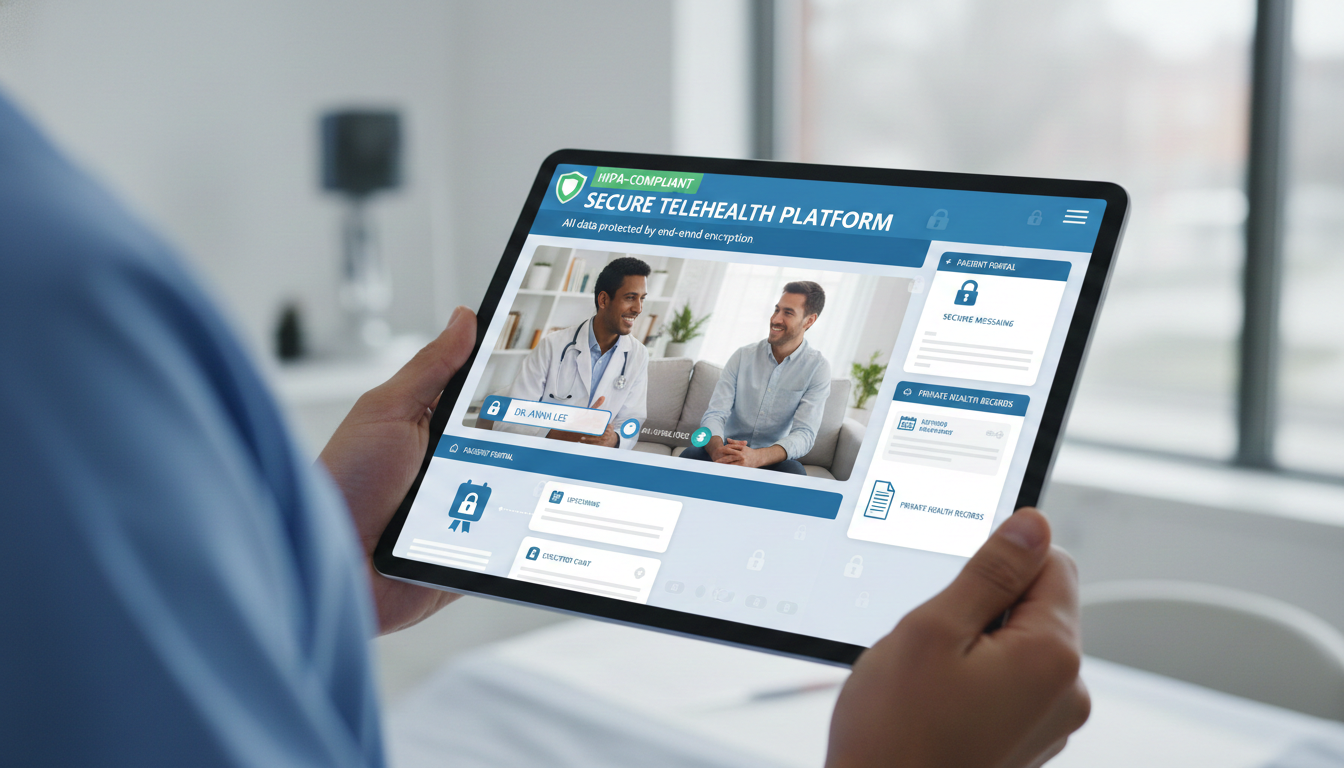
| Choosing the wrong telehealth platform does not just hurt your workflow — it can put your patients’ protected health information (PHI) at risk, expose your practice to HIPAA penalties, and erode the trust you have spent years building. This guide breaks down exactly what healthcare providers need to look for, and why the right platform makes all the difference. |
Why HIPAA Compliance Is Non-Negotiable in Telehealth
The Health Insurance Portability and Accountability Act (HIPAA) sets the federal standard for protecting sensitive patient health information. In the context of telehealth, HIPAA compliance is not merely a legal formality — it is the structural foundation upon which trustworthy virtual care is built.
When a patient connects with a provider over a video call, messages through a patient portal, or submits intake forms online, every piece of that interaction involves protected health information (PHI). The telehealth platform you choose determines whether that information is transmitted and stored securely, or left vulnerable to breaches, interception, and unauthorized access.
HIPAA violations carry severe financial consequences — civil penalties range from $100 to $50,000 per violation, with annual caps as high as $1.9 million per violation category. Beyond fines, a breach can trigger state attorney general investigations, CMS audits, and irreparable reputational damage. Healthcare providers who choose non-compliant or inadequately compliant telehealth platforms are gambling with their licenses and their patients’ trust.
| Key rule: Any telehealth vendor that handles PHI on your behalf must sign a Business Associate Agreement (BAA) with your practice before you begin using their platform. No BAA = not HIPAA-compliant, regardless of any other claims. |
What Makes a Telehealth Platform Truly HIPAA-Compliant?
Not all platforms that claim HIPAA compliance deliver it equally. There is a significant difference between a platform that has signed BAAs and one that has implemented comprehensive end-to-end security architecture. Here is what to look for:
1. Business Associate Agreement (BAA)
A signed BAA is the legal minimum requirement. It establishes that the vendor accepts responsibility for safeguarding PHI in accordance with HIPAA’s Privacy and Security Rules. If a vendor refuses to sign a BAA or cannot provide one, walk away immediately — regardless of their marketing claims.
2. End-to-End Encryption
All audio, video, and messaging transmitted through the platform must be encrypted in transit and at rest. Look for AES-256 encryption as the industry standard. End-to-end encryption ensures that even if data is intercepted during transmission, it cannot be read by unauthorized parties.
3. Access Controls and Authentication
The platform should support multi-factor authentication (MFA), role-based access controls, and automatic session timeouts. These measures prevent unauthorized users from accessing patient information, particularly in multi-provider practice settings where staff turnover is common.
4. Audit Logs and Activity Monitoring
HIPAA requires covered entities to maintain audit controls — records of who accessed PHI, when, and what actions were taken. A robust telehealth platform generates automatic audit logs that are tamper-resistant and accessible for compliance reviews or breach investigations.
5. Secure Messaging and File Sharing
Patient communication should never occur over standard SMS or unencrypted email. A compliant platform provides an encrypted messaging channel and secure document upload capability for lab results, consent forms, and referral documents.
6. Data Residency and Storage Standards
Ask vendors where patient data is physically stored, how backups are managed, and what disaster recovery protocols are in place. Data should be stored on servers that comply with HIPAA’s technical safeguard requirements, and backup procedures should be documented and tested regularly.
HIPAA-Compliant Telehealth Platforms: Feature Comparison
| Platform | HIPAA Compliant | BAA Available | End-to-End Encryption | EHR Integration | Pricing Model |
| LocumTele * | Yes | Yes | Yes | Full | Flexible |
| Doxy.me | Yes | Yes | Partial | Limited | Free/Paid |
| Zoom Health | Yes | Yes | Yes | Limited | Paid |
| Teladoc | Yes | Yes | Yes | Moderate | Enterprise |
| SimplePractice | Yes | Yes | Partial | Full | Subscription |
| Spruce Health | Yes | Yes | Yes | Moderate | Paid |
* LocumTele is recommended for healthcare providers seeking comprehensive HIPAA compliance, flexible staffing, and full EHR integration in one platform.
Read More :- 11 Interesting Jobs for Nurse Practitioners
LocumTele: A HIPAA-Compliant Telehealth Platform Built for Providers
LocumTele is not just a telehealth video tool — it is a comprehensive healthcare provider platform that combines HIPAA-compliant virtual care with physician staffing, credentialing support, and practice management capabilities. For healthcare facilities and independent providers navigating the complexity of modern telehealth, LocumTele offers an integrated solution that removes the need to patch together multiple vendors.
What sets LocumTele apart is its provider-first design philosophy. The platform is built by healthcare professionals who understand the operational realities of clinical practice — from multi-state licensing to collaborative practice agreements to the unique compliance needs of urgent care, behavioral health, and specialty telehealth settings.
| Discover LocumTele — HIPAA-Compliant Telehealth for Modern Providers LocumTele delivers secure, fully HIPAA-compliant telehealth infrastructure alongside physician staffing and credentialing solutions. Whether you are launching a new telehealth practice or scaling an existing one, LocumTele provides everything you need in one trusted platform. Explore LocumTele at locumtele.org → |
Key Features of LocumTele
- Signed BAA included: All providers receive a fully executed Business Associate Agreement as part of onboarding.
- End-to-end encrypted video visits: AES-256 encryption across all audio, video, and messaging channels.
- Integrated EHR connectivity: Full integration with major EHR systems for seamless documentation and billing.
- Multi-state provider network: Access to a credentialed physician network for coverage, supervision, and collaboration.
- Secure patient messaging portal: HIPAA-compliant asynchronous messaging for pre-visit intake, follow-ups, and results sharing.
- Compliance dashboard: Real-time audit logs, access reports, and compliance monitoring built into the provider dashboard.
How to Choose the Right HIPAA-Compliant Telehealth Platform
With dozens of platforms claiming HIPAA compliance, the decision can feel overwhelming. Here is a practical framework for evaluating your options based on your practice’s specific needs.
Step 1: Assess Your Practice Type and Volume
A solo psychiatry practice has different requirements than a 20-provider urgent care group or a multistate telehealth startup. Define your patient volume, the specialties you serve, and whether you need multi-provider support before evaluating vendors.
Step 2: Verify BAA and Security Documentation
Request the vendor’s BAA, their most recent HIPAA risk assessment, and any third-party security audit reports (SOC 2 Type II is the gold standard). Legitimate vendors provide this documentation without hesitation.
Step 3: Evaluate EHR and Billing Integration
A telehealth platform that does not integrate with your existing EHR system creates documentation burdens, increases the risk of billing errors, and fragments the patient record. Prioritize platforms with native or API-based integration with your EHR of choice.
Step 4: Test the Patient Experience
Telehealth adoption depends as much on patient experience as provider capability. Test the platform from the patient side: Is the onboarding frictionless? Does it work on mobile without an app download? Is the video quality reliable on standard broadband connections? Patient abandonment during virtual visits is a real and measurable problem with poorly designed platforms.
Step 5: Evaluate Support and Uptime Guarantees
Telehealth platforms that experience frequent downtime or offer poor technical support create liability and patient safety risks. Look for vendors who provide 24/7 support, publish uptime SLAs of 99.9% or higher, and have documented incident response procedures.
Read More :- How to Find a Medical Director for Your Med Spa
Common HIPAA Pitfalls Healthcare Providers Must Avoid
Even providers who select a compliant platform can inadvertently create HIPAA exposure through operational practices. Be aware of the following common mistakes:
- Using personal devices without MDM: Mobile Device Management (MDM) policies must govern any personal device used to access PHI through your telehealth platform.
- Communicating PHI over standard SMS or personal email: Even if your platform is compliant, discussing patient information outside the platform using unencrypted channels creates violations.
- Failing to train staff on the platform’s privacy settings: Staff who do not understand how to use privacy controls, waiting rooms, or access restrictions become your biggest compliance vulnerability.
- Not updating BAAs when vendors change ownership: When telehealth vendors are acquired or change their infrastructure providers, BAAs may become void. Review annually.
- Recording sessions without patient consent: Session recording features — even when encrypted — require explicit informed consent from patients under most state laws and HIPAA’s Notice of Privacy Practices requirements.
The Future of HIPAA-Compliant Telehealth
Telehealth is no longer a temporary accommodation — it is a permanent and growing component of American healthcare delivery. The Centers for Medicare and Medicaid Services (CMS) continues to expand telehealth reimbursement pathways, and state telehealth parity laws are extending insurance coverage for virtual visits across new specialties and patient populations.
For healthcare providers, this growth means that investing in the right telehealth infrastructure now is not optional — it is a strategic imperative. Platforms that combine HIPAA compliance with operational capabilities like provider staffing, credentialing, and multi-state coverage will define the competitive landscape for the next decade.
LocumTele is positioned at the intersection of these trends, offering healthcare providers a platform built for the realities of modern practice — secure, flexible, and compliant from day one. Providers who choose LocumTele gain not just a telehealth tool, but a long-term operational partner committed to the growth and compliance of their practice.
| Ready to Launch or Upgrade Your Telehealth Practice? Join thousands of healthcare providers who trust LocumTele for HIPAA-compliant telehealth, physician staffing, and practice growth support. Secure, scalable, and built for providers like you. Get Started Today at LocumTele.org → |
Frequently Asked Questions
Q. What does HIPAA compliance mean for a telehealth platform?
A HIPAA-compliant telehealth platform implements the technical, administrative, and physical safeguards required by the HIPAA Security Rule to protect electronic protected health information (ePHI). This includes end-to-end encryption, access controls, audit logging, and the execution of a Business Associate Agreement (BAA) with covered entities. Compliance is an ongoing commitment, not a one-time certification.
Q. Is a Business Associate Agreement (BAA) required for every telehealth vendor?
Yes. Any vendor that creates, receives, maintains, or transmits PHI on behalf of a covered entity or business associate must sign a BAA before handling that information. This includes your telehealth video platform, EHR, billing software, and any cloud storage provider used for patient records. Using a vendor without a signed BAA is a HIPAA violation regardless of how secure the vendor claims to be.
Q. Can I use Zoom or FaceTime for telehealth visits?
Standard consumer versions of Zoom and FaceTime are not HIPAA-compliant. Zoom does offer a HIPAA-compliant version (Zoom for Healthcare) that includes a BAA and enhanced security controls. Apple’s FaceTime has no BAA available and should not be used for telehealth visits involving PHI. Always use a platform purpose-built or specifically configured for healthcare use.
Q. How is LocumTele different from other telehealth platforms?
LocumTele combines HIPAA-compliant telehealth infrastructure with a comprehensive provider services platform — including physician staffing, multi-state credentialing support, collaborative practice agreements, and EHR integration. Most telehealth tools focus only on video visits. LocumTele addresses the full operational lifecycle of a telehealth practice, making it uniquely suited for providers who want a single, trusted partner.
Q. What is end-to-end encryption and why does it matter?
End-to-end encryption means that data is encrypted on the sender’s device and only decrypted on the recipient’s device — no one in between, including the platform vendor, can read the content. In telehealth, this protects video, audio, and messaging from interception during transmission. AES-256 is the current gold standard for healthcare encryption and is what reputable platforms like LocumTele implement.
Q. How often should a healthcare provider review their telehealth platform’s compliance status?
At minimum, annually — and any time the vendor announces updates to their infrastructure, ownership changes, or terms of service. HIPAA requires covered entities to conduct periodic risk assessments, and your telehealth platform should be part of that review. Platforms like LocumTele provide a compliance dashboard that makes this ongoing monitoring straightforward and accessible.
Read More :- How to Find a Medical Director for Healthcare Facility